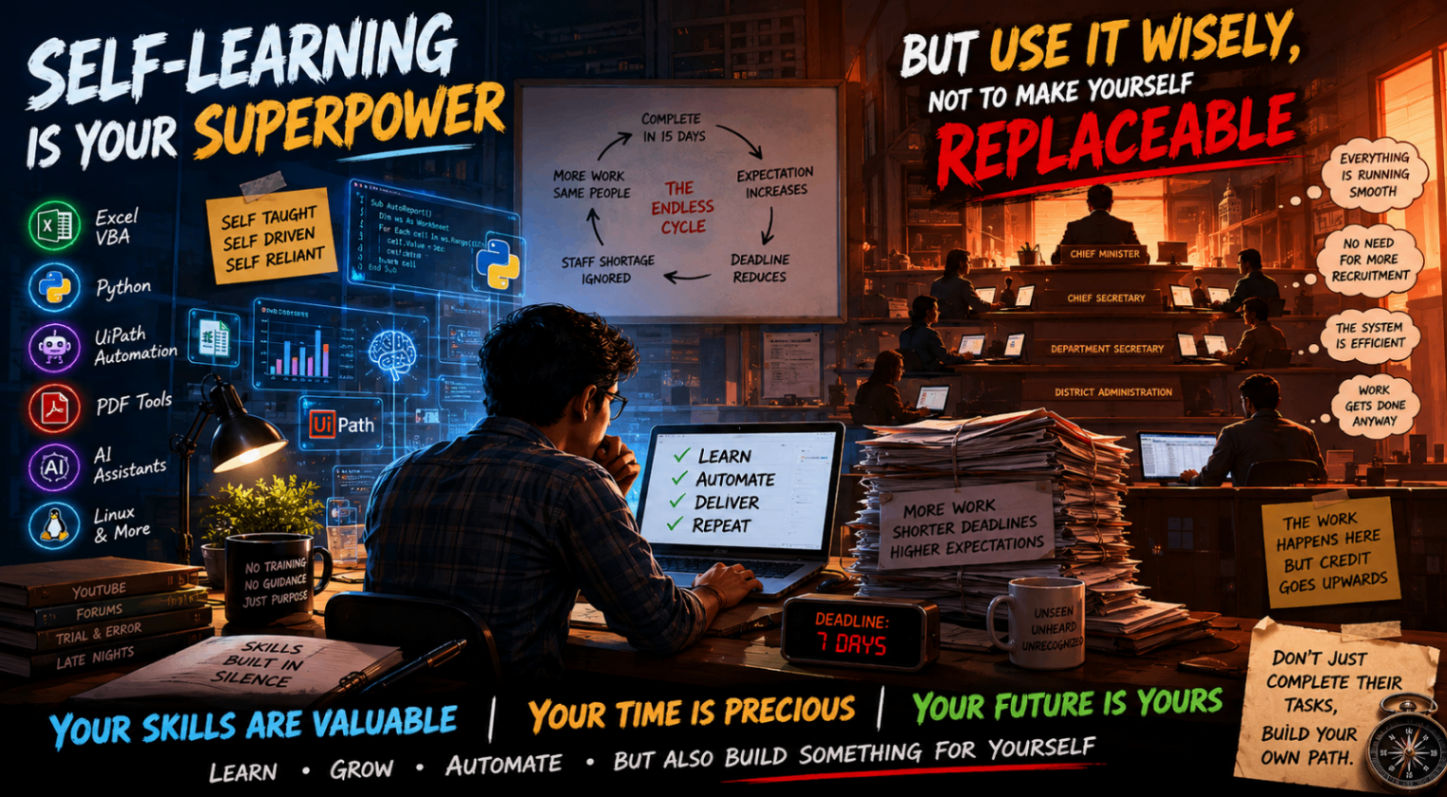
When Self-Learning Becomes Self-Poisoning: A Warning for GRSs, VLEs and Other Contractual Employees
For years, GRSs, VLEs, and other contractual employees have taught themselves Excel, VBA, Python, AI, and automation without formal training. While these skills help organizations meet impossible deadlines, they often hide manpower shortages, increase expectations, and leave the real contributors invisible. This article explores the hidden cost of self-learning and why technical skills should be used not only to serve a system, but also to build a better future for oneself.
Table of Contents
The Silent IT Revolution at the Bottom of the Government Hierarchy
Around twenty years ago, very few people expected Gram Rozgar Sahayaks (GRSs), Village Level Entrepreneurs (VLEs), and other contractual government workers to become technology experts.
Yet that is exactly what happened.
Faced with increasing workloads, impossible deadlines, and the constant pressure to perform better than everyone else, thousands of contractual employees began teaching themselves skills that were never part of their job descriptions.
They learned Excel formulas.
Then they learned VBA.
Then they learned PDF editing using software like Nitro PDF and open-source alternatives.
Some learned Python.
Some learned UiPath.
Some even became comfortable with Linux, server management, and AI tools.
Most importantly, they learned everything on their own.
No official training.
No mentors.
No technical support from higher authorities.
Just endless experimentation after office hours because failure was never an option.
For years, this self-learning culture looked like a success story.
But there is a hidden danger that very few people are talking about.
The People Above Never See the Real Work
The biggest problem is not technology.
The biggest problem is visibility.
Contractual employees sit at the lowest level of the administrative hierarchy.
They know exactly how much effort goes into every report, data entry task, reconciliation exercise, and compliance requirement.
But the people above them often see only the final output.
A complex task arrives.
The contractual staff automate parts of it using VBA, Python, AI, or UiPath.
A job that should have taken thirty days gets completed in fifteen.
The report reaches the next level.
Everything appears smooth.
The higher authority concludes that the task was never difficult in the first place.
The automation remains invisible.
The struggle remains invisible.
The late nights remain invisible.
Only the result is visible.
And that creates a dangerous illusion.
How Success Creates Impossible Expectations
Imagine a Chief Minister's office sets a deadline of thirty days for a major project.
At the ground level, contractual employees use every trick they know:
Excel automation
VBA macros
Python scripts
AI-assisted processing
Robotic Process Automation
The project is completed in fifteen days.
Everyone celebrates.
But what lesson does the system learn?
Not that employees worked extraordinarily hard.
Not that technology was heavily used.
Not that individuals sacrificed personal time to meet targets.
Instead, the system learns that the work can be completed in fifteen days.
The next project arrives.
This time the workload is three times larger.
The deadline becomes seven days.
And the cycle continues.
The Best Performers Become the Benchmark for Everyone Else
Another problem soon emerges.
Not every employee possesses the same skill level.
Many workers still struggle with basic Excel functions.
Others may not know automation tools at all.
Yet management rarely measures capability differences.
Instead, the most skilled workers become the benchmark.
The question becomes:
"If one person can do it in seven days, why can't everyone else?"
The exceptional performer stops being exceptional.
Their performance becomes the new minimum expectation.
The reward for efficiency becomes more work.
The Recruitment Trap Nobody Notices
There is another consequence.
Many government offices suffer from severe staff shortages.
Positions remain vacant for years.
In theory, this should justify recruitment.
But what does the system observe?
Despite operating with only half the required manpower, targets are still being achieved.
Reports are submitted.
Data is processed.
Projects move forward.
From the top, it appears that everything is functioning normally.
The conclusion becomes obvious:
"If the work is already getting done, why recruit more people?"
The efficiency created by self-learning starts masking the actual manpower crisis.
Ironically, the very people compensating for staff shortages become the reason those shortages remain unaddressed.
The Invisible Worker Problem
The situation becomes even more complicated because of administrative protocol.
In many cases, the actual work is performed by contractual staff.
But on paper, responsibility belongs to permanent employees.
Official logins are often assigned to permanent staff.
Official records show permanent staff as task owners.
Official reports move upward through permanent channels.
As information climbs the hierarchy, each level naturally receives recognition for successful completion.
The person who automated the work remains invisible.
The system sees efficiency.
But it does not see who created it.
As a result, policymakers often assume that existing structures are highly productive, when in reality they are being held together by a small number of self-taught contractual workers.
The Dangerous Habit of Showing Off Automation
Many of us are proud of our technical skills.
And we should be.
Learning VBA, Python, AI, or UiPath without formal training is an achievement.
But there is a difference between using a tool and advertising it.
Every time we casually mention:
"I automated it using Python."
"UiPath handled that task."
"AI generated this report."
"A script completed it automatically."
we may be creating expectations that the system does not fully understand.
At a small scale, personal automation works.
At enterprise scale, things are very different.
Enterprise automation requires:
Software licenses
Infrastructure
Security audits
Maintenance contracts
Professional support
Dedicated budgets
None of these come cheap.
Yet officers who hear only the success stories may assume that automation is easy, free, and infinitely scalable.
What Happens When the System Decides to Automate Everything?
Eventually, a day may come when management faces serious pressure.
Deadlines become impossible.
Targets become unrealistic.
Someone remembers those magical words:
"Automation."
"AI."
"UiPath."
"Python."
This time, however, management wants results at scale.
When internal staff cannot deliver enterprise-level solutions, consultants are called.
Technology firms are hired.
External vendors analyze workflows.
A proposal arrives.
Perhaps it costs only a few hundred rupees per user per month.
Perhaps it replaces large portions of manual work entirely.
At that point, the question becomes uncomfortable.
What happens to the contractual worker who spent years proving that technology could do the job faster?
Use Self-Learning Wisely
The solution is not to stop learning.
The solution is to stop giving away the full value of that learning for free.
Technical skills are powerful assets.
They should not exist solely to help an organization increase expectations without increasing recognition, compensation, or opportunities.
Learn VBA.
Learn Python.
Learn AI.
Learn automation.
But also ask a simple question:
"What am I building for myself?"
Can those skills create a side business?
Can they generate freelance income?
Can they lead to consulting opportunities?
Can they help secure a better position?
Can they build long-term financial security?
Skills are investments.
An investment should produce returns for the person who made it.
Final Thoughts
Self-learning is one of the greatest strengths of contractual employees.
It has helped countless workers overcome limitations that should never have existed in the first place.
But self-learning becomes dangerous when it only serves to increase workloads, hide staffing shortages, and create unrealistic expectations.
The purpose of learning should not be to make oneself more expendable.
The purpose of learning should be to create freedom, opportunity, and a better future.
Learn continuously.
Improve relentlessly.
But make sure at least part of that effort is building something that belongs to you.
Subho
Automation Engineer · Self-Taught Technologist
Self-taught technologist building practical tools for automation, infrastructure, and real-world problem solving. Based in India.